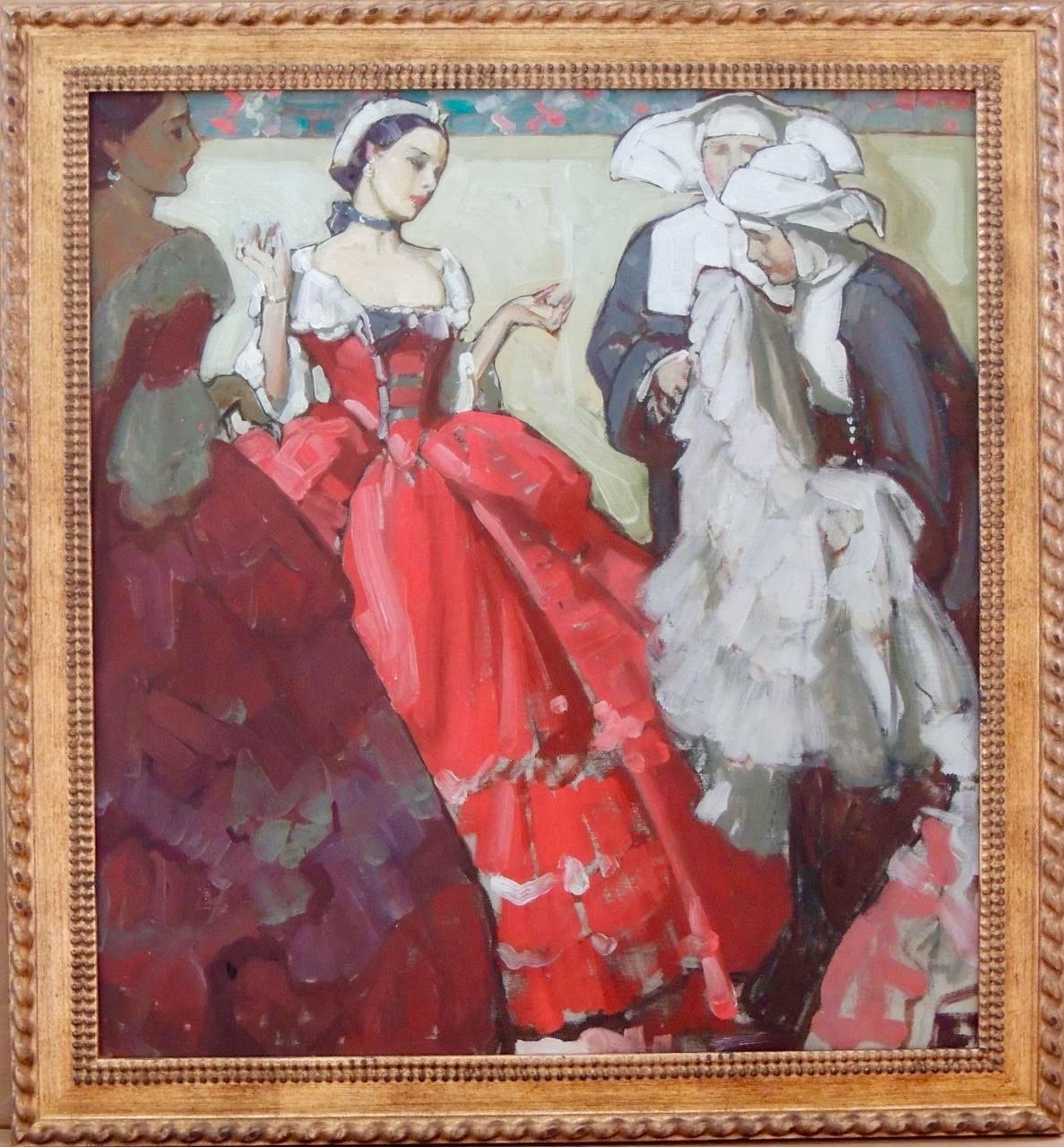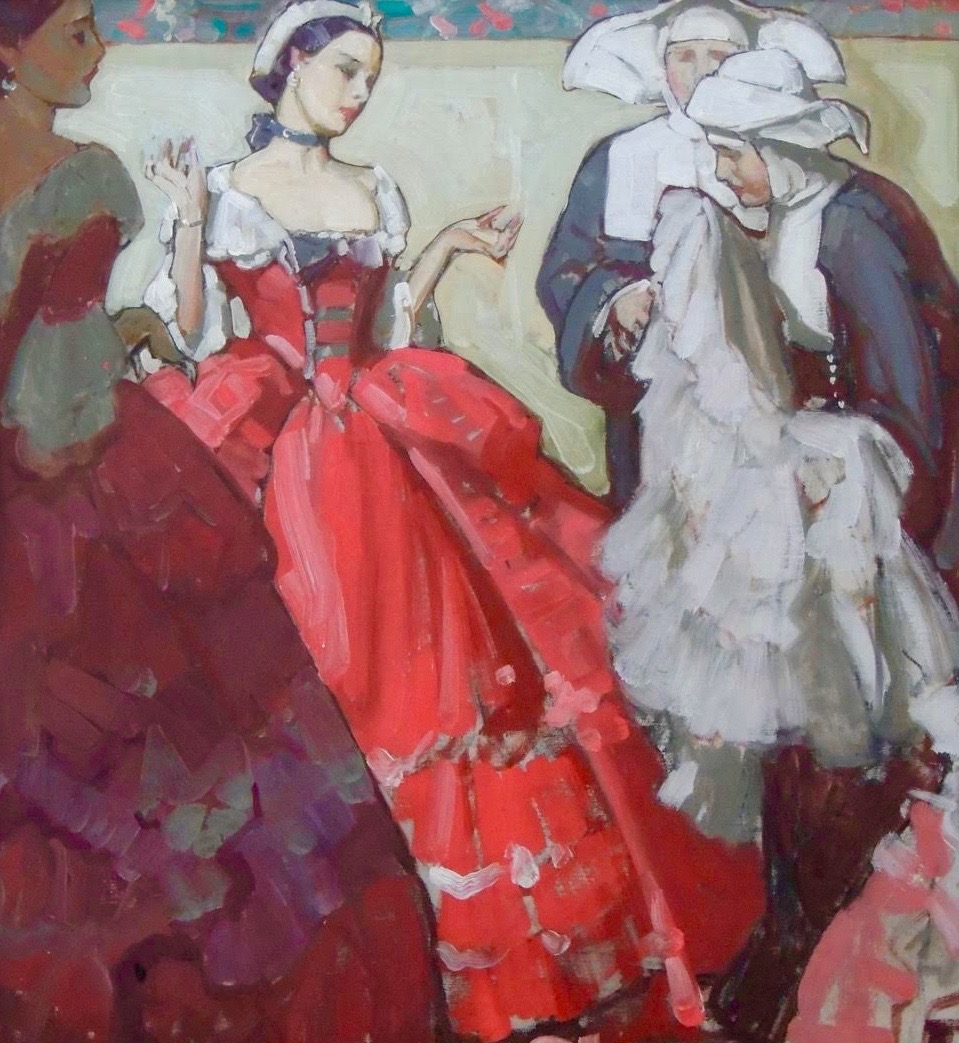
"“For A Discriminating Clientele: Spanish Lace” Proposed Packard Motor C" Lot no. 2881
By Mead Schaeffer (American- 1898-1980)
1929 (Estimated)
26.00" x 24.00", Framed 30.25" x 28.25"
Oil on Canvas
REQUEST PRICE
PURCHASE REQUEST
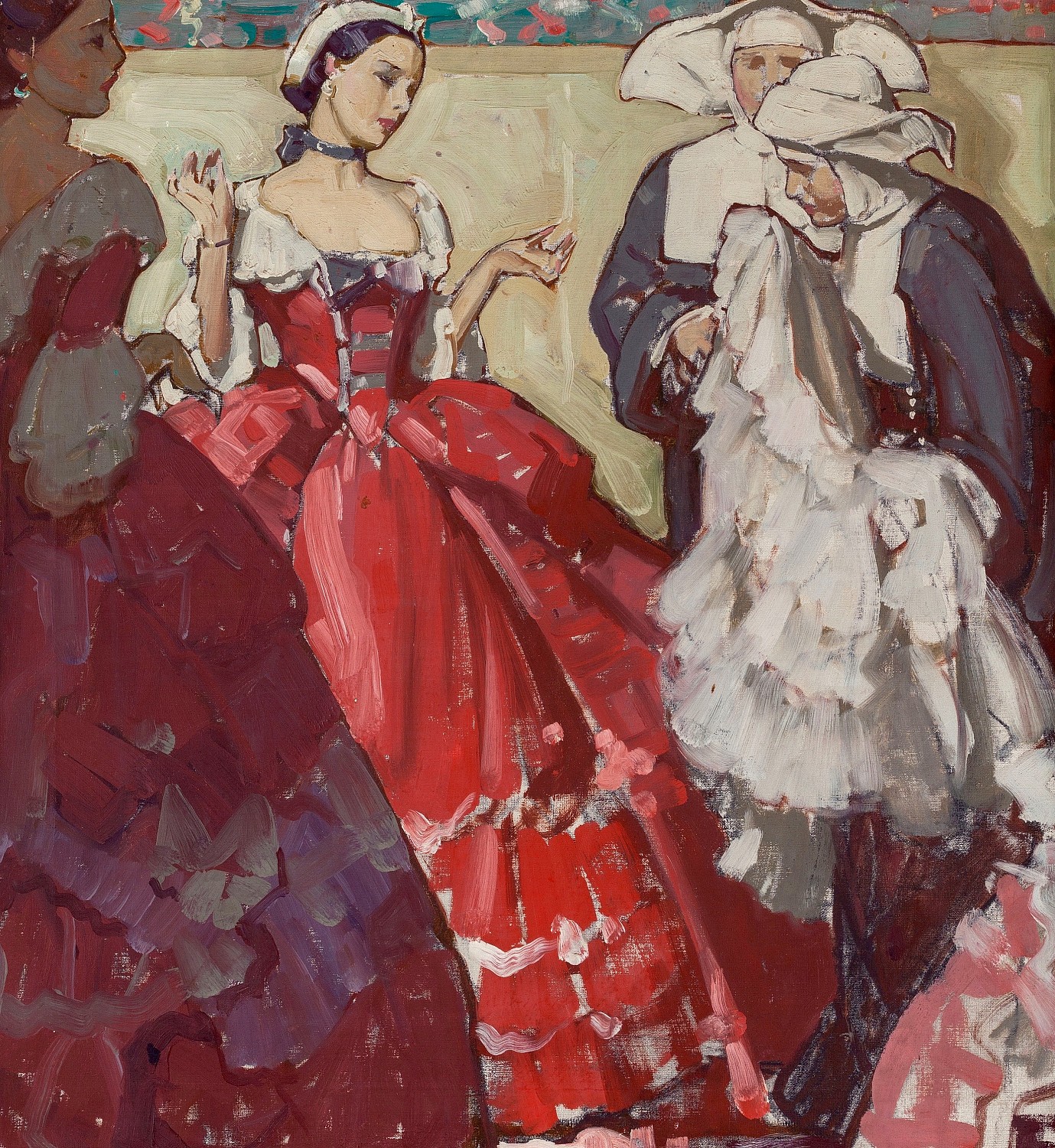
Original proposed advertisement for Packard Motor Company, circa 1929.
Though Packard automobiles ceased production in 1956, their reputation for elegance and fine engineering endures. This is due in part to the quality of the product itself, but also to their remarkably effective advertising campaigns. In their heyday, Packards were renowned for sumptuous style, exquisite craftsmanship, and a premium price tag.
Beginning in the late 1920s, the Packard Motor Company launched an innovative advertising campaign that went beyond simply showcasing a car, but painted a vivid picture of the glamorous lifestyle associated with owning one. Advertisements often paid tribute to renowned visual and performing artists and master craftspeople, or depicted consumers in elegant attire in exotic locales. This strategic approach aimed to emphasize Packard's appeal to a "discriminating clientele." This phrase was crafted to attract a sophisticated and discerning customer base by highlighting the vehicle's luxury and exclusivity.
Every Packard advertisement also featured a powerful slogan designed to inspire further confidence in the product: "Ask the man who owns one." First appearing in 1901, this confident declaration positioned Packard as a clear symbol of status and success. This groundbreaking concept of associating a consumer product with an aspirational lifestyle of wealth and sophistication was revolutionary at the time and set the standard for countless advertising campaigns that followed. (Reference: "Vintage Advertising: Selling Luxury" by Jeff Nilsoon for The Saturday Evening Post online, published November 15, 2016)
Artist Mead Schaeffer, in an interview published in the Autumn 1977 issue of The Packard Cormorant, observed that "People were paying for the status of Packard ownership as much as for the excellence of the cars. It was a challenge to every artist who illustrated for Packard to portray this." Schaeffer himself produced four oil paintings for the "Discriminating Clientele" campaign, exploring themes such as Duncan Phyfe, Spanish Lace, Oriental Rugs, and Russian Ballet. Schaeffer's "Spanish Lace" illustration was not selected for publication; instead, an illustration by Saul Tepper was used. Both Schaeffer’s unpublished proposal and Tepper’s published illustration are part of our gallery’s collection. (Reference: "Pictures at an Exhibition" by Ed Heys for Hemmings.com, updated March 26, 2024)
Mead Schaeffer and Saul Tepper Evoke The Excellence of Packard Engineering through Spanish Lace
While we can only speculate about the art director's decision, it's intriguing to consider why Tepper’s artwork was chosen over Schaeffer’s for the "Spanish Lace" theme. Both pieces depict a woman admiring Spanish lace. Schaeffer's image shows a woman admiring a finished piece of lace as it is presented to her. Tepper’s image, however, portrays a woman looking down to admire the meticulous handiwork of a lacemaker creating the intricate product using the bobbin method—a process involving braiding and twisting thread lengths wound on bobbins, with pins holding stitches in place. Bobbin lace boasts a rich history in Spain, particularly in regions like Camariñas and Almagro.
Although both paintings use loose brushstrokes that merely suggest the lace's intricacy, it’s plausible that showcasing an admiration for the act of creation of the luxurious textile would more effectively convey Packard’s intended association with the impeccable construction of their automobiles. The published caption reinforced this idea: “Willing years of patient artistry are often gladly devoted to a single piece of rare and exquisite lace.” This focus on the dedicated artistry behind the lace likely resonated with Packard's emphasis on engineering excellence.
Explore related art collections: Automotive/Transport / $5,000 - $20,000 / Fashion / Advertisements / Women as Subjects / 1920s / Cultural / Historical / Newly Researched
See all original artwork by Mead Schaeffer
ABOUT THE ARTIST
The work of Mead Schaeffer divides itself into two periods. The early one deals with romantic, swashbuckling and theatrical subjects. The second, although still strong and dramatic, is based on authentic, factual themes and is more reportorial.
Born in Freedom Plains, New York, he studied at Pratt Institute, and got advice from Harvey Dunn and Dean Cornwell. A brilliant student, he was illustrating for major magazines while still in his twenties and had begun a series of sixteen illustrated classics for Dodd, Mead, including The Count of Monte Cristo, Les Miserables, Typee and Moby Dick. Eventually, he wanted to deal with contemporary subjects that he could personally observe and learn about.
With this objective, Schaeffer began to paint covers for The Saturday Evening Post, which by 1940 was featuring themes of Americana. The Post’s artists traveled to various parts of the country to find regional material with national appeal. Schaeffer made an extended trip to the West with his friend and fellow-artist Norman Rockwell. From this and other trips, many fine covers resulted.
During World War II, Mead painted a notable series of Post covers of American soldiers representing various branches of the service. The paintings were done with the full approval and cooperation of the United States military authorities, who provided all the facilities. In researching the pictures, Schaeffer rode abroad a submarine, a Coast Guard patrol boat and various aircraft. Later, under the sponsorship of the Post, the paintings were exhibited in more than ninety cities in the United States and Canada in promoting the war effort. They are now part of the permanent collection of the USAA, an association of military officers, former officers and their families, in San Antonio, Texas.
In other exhibitions, Schaeffer won the Salmagundi Club’s Shaw Prize in 1930, and a Gold Medal at the Pennsylvania Academy of the Fine Arts in 1944.