
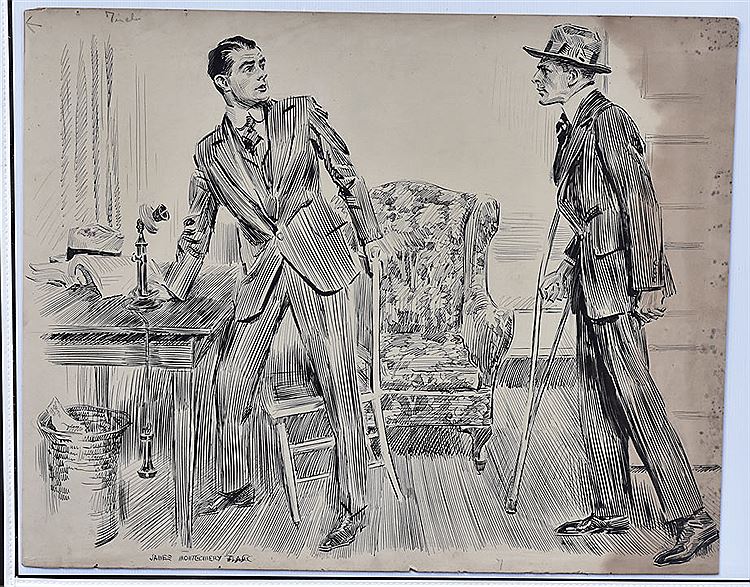
""Three Fingered Jerry", McClure's Magazine" Lot no. 3310
By James Montgomery Flagg (1877-1960)
21.50" x 27.00"
Ink on Board
Signed Lower Right
REQUEST PRICE
PURCHASE REQUEST
Explore related art collections: $100 - $5,000 / Black & White / Magazine Stories / Men
See all original artwork by James Montgomery Flagg
ABOUT THE ARTIST
James Montgomery Flagg lived with gusto. He epitomized the public concept of the handsome, bohemian artist, surrounded by beautiful models, dashing off pictures with sheer exuberance of talent. In Flagg’s case, this was nearly true. He worked rapidly and easily in all media and with any subject matter. Humor and satire were his special forte.
Early in his career he did a cartoon entitled “Nervy Nat,” and for many years he illustrated the zany characters of the P. G. Wodehouse stories and created the prototypical interpretation of the valet, “Jeeves.” His rapid portrait studies and incisive caricatures were prized by many prominent sitters.
For over thirty years he turned out an immense amount of work, including many posters during World War I. Probably his best known illustration was the famous “I Want You” Uncle Sam recruiting poster. Over four million copies of this were printed and distributed throughout the country.
Flagg was a painter of serious portraits, too. He exhibited in the Paris salon of 1900, at the National Academy of Design, and the New York Watercolor Club. He was elected to the Illustrators Hall of Fame in 1980.