
"My Duty Towards my Neighbor, and My Duty Towards God (diptych)"   Lot no. 4092

Add to Want List


By Maxfield Parrish (1870-1966)

1898 (Estimated)
Each: 33" x 48"
Each: Oil on Panel
Signed & Dated Lower Right, ii: Signed & Dated Lower Left

REQUEST PRICE


PURCHASE REQUEST
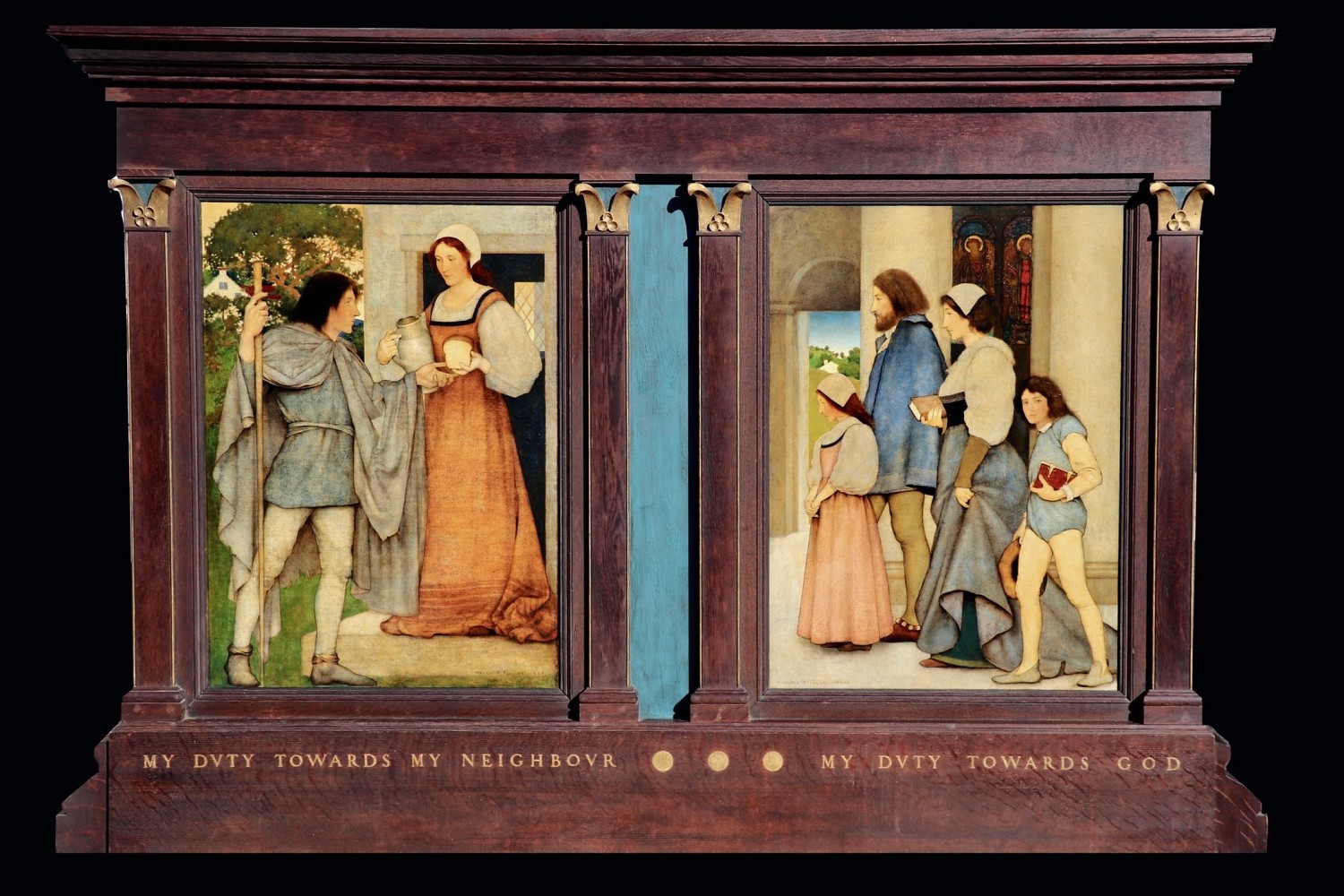

This diptych was commissioned for the Mrs. Parsons Chapel at Trinity Episcopal Church in Lenox, Massachusetts. Art historian Coy Ludwig observed the works possess an "interesting Pre-Raphaelite quality" reminiscent of the American Arts & Crafts Movement. While the faces and costumes evoke the styles of Rossetti and Waterhouse, the frame's design, colors, and lettering reflect the influence of the Arts and Crafts aesthetic. Parrish clearly intended a fully integrated artistic expression, recognizing that independent framing would have compromised his intended overall effect.
The overall composition, including its artist-designed frame, reveals Parrish's working methods and his natural artistic inclinations. His initial architectural interests, evident in his early education, made this site-specific commission a natural fit. The deliberate selection of an architectural space within an existing structure further underscores his innate interest in architecture. Moreover, these intimate murals exemplify Parrish's early artistic approach, characterized by a flat, linear style directly informed by his poster and cover designs, which relied on strong contours and silhouettes for impactful visual communication.

This diptych was commissioned for the Mrs. Parsons Chapel at Trinity Episcopal Church in Lenox, Massachusetts. Art historian Coy Ludwig observed the works possess an "interesting Pre-Raphaelite quality" reminiscent of the American Arts & Crafts Movement. While the faces and costumes evoke the styles of Rossetti and Waterhouse, the frame's design, colors, and lettering reflect the influence of the Arts and Crafts aesthetic. Parrish clearly intended a fully integrated artistic expression, recognizing that independent framing would have compromised his intended overall effect.


The overall composition, including its artist-designed frame, reveals Parrish's working methods and his natural artistic inclinations. His initial architectural interests, evident in his early education, made this site-specific commission a natural fit. The deliberate selection of an architectural space within an existing structure further underscores his innate interest in architecture. Moreover, these intimate murals exemplify Parrish's early artistic approach, characterized by a flat, linear style directly informed by his poster and cover designs, which relied on strong contours and silhouettes for impactful visual communication.


Literature: 

Coy Ludwig, Maxfield Parrish, New York, 1973, p. 153, nos. 194-95, illustrated

Alma Gilbert, Maxfield Parrish: The Masterworks, Berkeley, California, 1992, p. 116 (as My Duty Towards God and My Neighbor)

Laurence S. Cutler, Judy Goffman Cutler, Maxfield Parrish and the American Imagists, Edison, New Jersey, 2004, p. 299,mentioned


Explore related art collections: 1800s / $100,000 & Above / Historical

See all original artwork by Maxfield Parrish

ABOUT THE ARTIST

To behold the work of American illustrator Maxfield Parrish (1870–1966) is to enter into a fantasy world of ethereal beauty. Whether a book illustration, magazine cover, painting or mural commission, his flawlessly rendered subjects and fairy-tale settings are infused with a sense of mythical beauty unmatched by any artist in his wake

A Unique Approach

The magic and sublime spirit of Parrish’s work is the result of his unique approach to painting. He began with a white base which served to illuminate the image from the first layer up through to the last. Repeated layering of varnish on the surface of the pigment heightened the vibrancy of his colors, yielding shades like the famous "Parrish blue," a rich cobalt that is now indelibly associated with the artist. This singular technique allowed Parrish to convey textures and patterns with the intense detail and saturation of color that became trademarks of his best works.

This May, a museum-quality collection of 11 works by Maxfield Parrish pay tribute to the superior talent and unique vision of this seminal artist. A leading highlight of the collection is Sing a Song of Six Pence, measuring over 13 feet long and painted as a mural for the hotel bar of the Sherman House in Chicago, Illinois. Parrish began his career painting a mural of Old King Cole for the University of Pennsylvania in 1894, and was immediately recognized for his ability to render exquisite detail on a monumental scale. He often projected photographic images and then painted directly on the surface of his murals, which may account for the veracity of the features displayed in this work.