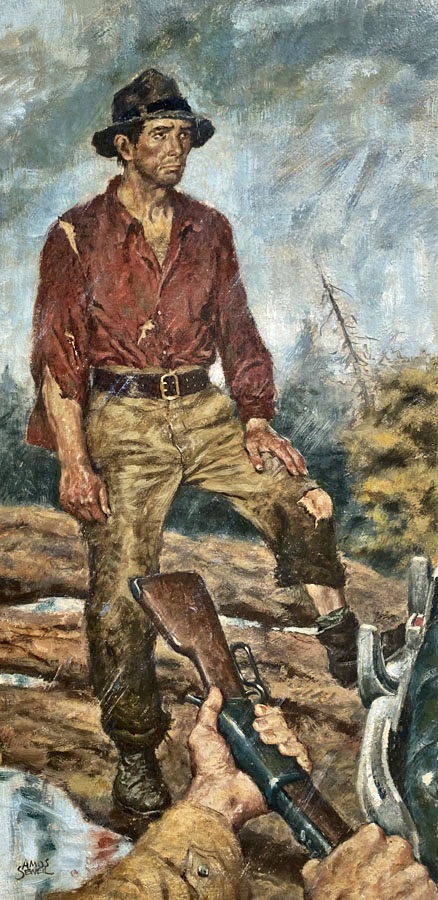
"The Hunter" Lot no. 4255
By Amos Sewell (American- 1901-1983)
1930
21.00" x 14.00"
Oil on Board
Signed Lower Left
REQUEST PRICE
PURCHASE REQUEST
Explore related art collections: Sports / Magazine Stories / Men / Dark/Somber / $100 - $5,000
See all original artwork by Amos Sewell
ABOUT THE ARTIST
Amos Sewell had a special empathy for children and also particularly enjoyed depicting homespun, rural subjects. These special gifts were ideally combined in the illustrations he made for a series of stories about Babe, Little Joe, Big Joe, and Uncle Pete by R. Ross Annett that ran for over twenty years in The Saturday Evening Post.
Sewell was born in San Francisco and studied nights at the California School of Fine Arts, working days in a bank. After some years of this, he decided to try his luck as an illustrator in the East. To get there, he shipped out as a working hand on a lumber boat going by way of the Panama Canal.
In New York, he studied at the Art Students League and at the Grand Central School of Art. Among his teachers were Guy Pene DuBois, Julian Levi and Harvey Dunn. At the same time, he began to draw black and white dry-brush illustrations for the Pulp magazines.
He illustrated his first major manuscript for The Country Gentleman in 1937; next came The Saturday Evening Post, for which he subsequently also painted many covers. This led to commissions from other national magazines. Sewell also illustrated for many major advertisers, and his work won awards from the Art Directors Clubs of New York and Cleveland, were exhibited at the Society of Illustrators, and included in traveling exhibits both here and abroad.